

Design philosophies
The key purpose of a Design Philosophy is to enable OEM designers to better understand the basis of the hazards that occur in the normal operation and maintenance of surface earth moving equipment. By integrating the solution to these problems it will help the OEM’s to design equipment with hazards reduced to an acceptable level. Each Design Philosophy follows a similar format that describes the EMESRT viewpoint on objectives, general design outcomes and hazards to be mitigated.
The Objective for each Design Philosophy is to minimise the potential of unwanted events, related to that topic, to As Low As Reasonably Practicable, or ALARP. Mining companies generally manage hazards to ALARP through the use of the Hierarchy of Controls, otherwise known as the Safety Precedence Sequence. This approach to managing hazards underpins the format of the EMESRT Design Philosophies.
The General Outcome for each Design Philosophy outlines the expectations for design outcomes that reduce hazards to ALARP. The intended design outcome of each Design Philosophy is that hazards should be addressed during the life cycle of the design process rather than after the equipment has left the factory.
Within the Design Operability and Maintainability Analysis Technique (OMAT) process, DP’s are a means of aligning various hazards (such as equipment access and egress, working at heights, tires and rims, fire, etc), by putting them into appropriately similar categories.

Design Philosophy 1: Access and working at heights
The objective is to prevent harm related to access and working at heights (where there is a possibility of falling at least 6’ (1.8 m) or if serious harm may result) on equipment; to prevent slip/trips, sprains/strains, entrapment, falls from height and failure to egress in emergency events to as low as reasonably practical, including consideration in design for foreseeable human error.
For example, injury during access to equipment and its routine service and inspection points, work platforms and operator workstations due to poor location of service and inspection points, etc.

Design Philosophy 2: Tyres and rims
The objective is to prevent harm related to tyre and rim events to as low as reasonably practical, including consideration in design for foreseeable human error and material failures.
For example, harm due to uncontrolled release of pressure from the tyre and rim assembly during operation and maintenance.

Design Philosophy 3: Exposure to harmful energies
The objective is to prevent harm related to exposure to moving machine parts, failure of hydraulic equipment or systems, or other energy sources, such as compressed air, heat, electricity and gravity to as low as reasonably practical, including consideration in design for foreseeable human error.
For example, harm from exposure to energies such as heat, electricity, radiation, compressed air, high pressure fluids (including hydraulic fluids) and falling objects.
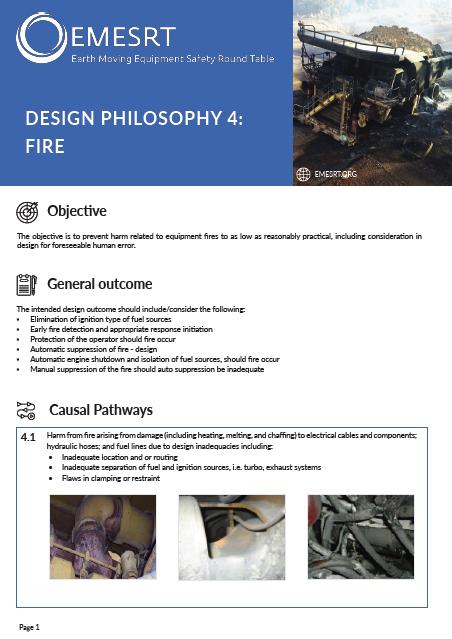
Design Philosophy 4: Fire
The objective is to prevent harm related to equipment fires to as low as reasonably practical, including consideration in design for foreseeable human error.
For example, harm from fire arising from damage (including heating, melting and chaffing) to electrical cables and components, hydraulic hoses and fuel lines due to design inadequacies including poor location, inadequate separation of fuel and ignition sources, and flaws in clamping or restraints.

Design Philosophy 5: Machine operation and control
The objective is to prevent harm, during machine operation and control, to as low as reasonably practical, including consideration in design for foreseeable human error.
For example, musculoskeletal injury or illness due to workstation design (including seat and seatbelt design, openings and cab height) that promotes biomechanically compromised postures for the 5th percentile female to 95th percentile male body dimensions.

Design Philosophy 6: Health impacting factors
The objective is to prevent harm from exposure to health impacting factors to as low as reasonably practical, including consideration in design for foreseeable human error.
For example, harm from exposure to health hazards such as extreme temperatures, excessive vibration and noise levels, particulates, gases and vapours within the operating workspace; and musculoskeletal factors due to poor ergonomic design of equipment and controls.

Design Philosophy 7: Manual tasks
The objective is to prevent harm due to manual tasks during installation, maintenance and operations of equipment, to as low as reasonably practical, including consideration in design for foreseeable human error.
For example, musculoskeletal injury from exposure to risk factors such as forceful exertion, awkward or static posture, repetition or prolonged duration, and hand-arm and/or whole-body vibration due to manual tasks associated with installing, operating and maintaining the equipment.

Design Philosophy 8: Confined spaces and restricted work areas
The objective is to prevent harm to people working in confined spaces and restricted work areas to as low as reasonably practical, including consideration in design for foreseeable human error.
For example, asphyxiation from irrespirable atmosphere due to lack of adequate ventilation.
Operability and maintainability analysis technique
Within the Operability and Maintainability Analysis Technique (OMAT), the EMESRT Design Philosophies (DP’s) guide the assessment process by providing a source of issues or topics to focus the human factors analysis. They cover human factors hazard potentialities such as equipment access and working at heights, tyres and rims, fire, exposure to harmful energies, machine operation and control, health impacting factors, manual tasks and confined spaces and restricted work areas
This list may change as new design hazard factors are identified or others eradicated.
DP’s present an EMESRT aligned viewpoint on objectives, general design outcomes and hazards to be mitigated. The aim of the DP’s is to provide information to help the OEM design equipment with hazard reduced to an acceptable level, including consideration for foreseeable human error. They have been developed as set of pages of information, supported by images that depict an example of the issue.
The ‘hazards to be mitigated’ section (now termed “causal pathways”) documents the significant and common hazards that are evident through the use of equipment at mine sites, and which could be improved through human factors engineering by the OEM.
Each statement has a corresponding illustration. The causal pathways found in each design philosophy will serve as the main hazards to be assessed when completing the OMAT.
NOTE: Please use the current Design Philosophies listed above when working through the OMAT process.
The EMESRT Design Evaluation for Earthmoving Equipment Procurement (EDEEP) technique is a suite of tools that is supported by the OMAT principles. It was developed to help OEM’s demonstrate how they have addressed the problems set out in the DP’s. Meanwhile, using the design philosophies helps industry members thoroughly evaluate OEM equipment at a residual risk within maintenance and operability tasks.
The EDEEP document is made up of key sections directing the user towards a final document to be supplied to the purchaser for evaluation. These sections include:
- Critical Task Identification information
- Design Philosophy reference information
- Task Based Hazard Assessment document information
- Design feature information from the task based hazard assessment document
EDEEP enables mining companies considering purchasing equipment to obtain high quality information about equipment design hazard mitigation in a standardised form. Completing the EDEEP process or equivalent will give OEM’s the information they need to design equipment ‘beyond standards.’
NOTE: Please use the current Design Philosophies listed above when working through the EDEEP process.
Design Evaluation for Earthmoving Equipment Procurement Technique
For more information regarding the Design Philosophies, OMAT or EDEEP please contact EMESRT via enquiries@emesrt.org.