
ICSV Vehicle Interaction Leading Sites Forum 2026: Strengthening the Foundations for Safer Mining

ICSV Vehicle Interaction Leading Sites Forum 2026: Strengthening the Foundations for Safer Mining
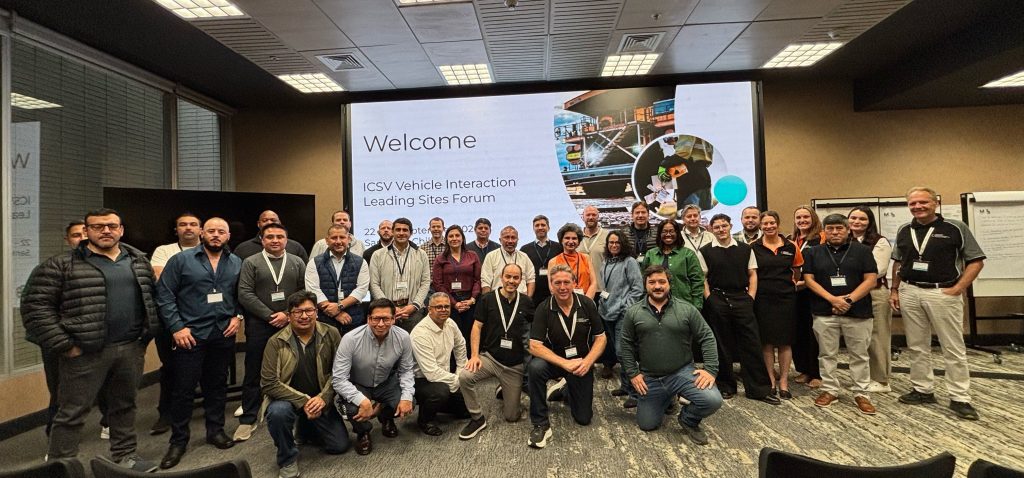
 

The ICMM/EMESRT Innovation for Cleaner, Safer Vehicles (ICSV) Vehicle Interaction Leading Sites Forum brought together mining professionals from around the world in Santiago, Chile, from 22-24 September 2026 to share experiences, explore leading practices and collaborate on one of the industry’s most critical challenges: reducing vehicle interaction risk. The forum marked the first Leading Sites event held at scale in Latin America and attracted 43 delegates from 17 mining companies, alongside industry experts and program leaders.

A Collaborative Approach to Vehicle Interaction Risk

Over three days, delegates worked through the EMESRT 9 Layers of Defence, Operational Effectiveness validation processes and approaches for developing practical vehicle interaction improvement roadmaps. The forum was designed to help participants better understand how technology, operational controls and human factors must work together to reduce fatal incidents and improve operational effectiveness.

A key theme emerged throughout the event: technology alone is not the solution. Delegates consistently reinforced the need to establish strong foundations through site requirements, vehicle separation, operating procedures, governance and workforce readiness before relying on advanced technologies such as collision avoidance systems (CAS).
 

From Technology Focus to Readiness Focus

While many participants arrived seeking insights into technology integration, discussions quickly shifted towards organisational readiness and operational effectiveness. Delegates highlighted the importance of understanding current controls, identifying gaps and validating performance before introducing new technology solutions. Across multiple discussions, workshops and polling activities, participants reinforced the principle of “foundations before technology.”

The forum also explored the relationship between Technology Readiness Levels (TRL), Commercial Readiness Levels (CRL) and Human Readiness Levels (HRL).
 

The Value of Peer Learning

One of the strongest outcomes from the forum was the value participants placed on peer-to-peer collaboration. Delegates openly shared lessons learned from incidents, technology deployments, operational challenges and successful interventions. Discussions included practical examples of vehicle separation initiatives, alarm management strategies, fatigue management programs and approaches to integrating collision avoidance systems into operational workflows.
 
Ninety-six percent of participants rated peer discussions as very or extremely useful, highlighting the importance of creating opportunities for mining professionals to learn from each other’s experiences in a collaborative, non-competitive environment.
 

Looking Ahead

Several priority areas emerged for future collaboration, including:
  • Establishing ongoing peer networks and working groups between forums.
  • Increasing focus on underground vehicle interaction challenges.
  • Advancing interoperability and industry standards for safety technology.
  • Expanding translated resources and regional engagement across Latin America.

The forum reinforced a clear message for the industry: successful vehicle interaction operational effectiveness requires more than technology. It depends on strong systems, effective governance, human-centred design and a commitment to continuous learning and collaboration. By working together and sharing practical experiences, the mining industry can continue progressing towards safer, more effective operations.
 
We extend our thanks to ICMM, the forum facilitators, presenters, participating organisations and all delegates who contributed openly and candidly throughout the event. Their willingness to share insights and experiences continues to strengthen the industry’s collective ability to improve vehicle interaction safety.